


Fallstudien > Transparent thermoplastic sheet materials: the best choice for your project

When it comes to glazing materials, glass is often the first choice. But did you know that transparent thermoplastic sheets offer significant advantages in many applications? Consider materials such as polycarbonate (PC), polymethyl methacrylate (PMMA), and styrene acrylonitrile (SAN). Each of these plastics has unique properties that make them suitable for different applications. In this blog, we will take you through the selection criteria for the right transparent thermoplastic sheet materials and their advantages over traditional glass.
Glass vs. thermoplastics: a comparison
Glass has very high hardness and rigidity, which makes it particularly scratch- and abrasion-resistant. It also offers excellent resistance to chemicals and is very stable for outdoor use. However, glass is heavy and brittle, making it less suitable for applications where mobility and impact resistance are important. Moreover, glass is difficult to work with; cutting, assembling and forming.

Figure 1. Stress/strain curves of glass and polycarbonate
Thermoplastics
- Polycarbonate (PC):
- Properties: Light, superior impact resistance, good flame resistance.
- Applications: Safety applications such as machine glazing, vehicle glazing, and personal protective equipment.
- Polymethylmethacrylate (PMMA):
- Properties: Light, moderate impact resistance, very high light transmission and gloss.
- Applications: Signage and graphics applications.
- Styrene Acrylonitrile (SAN):
- Properties: Lowest density, high stiffness, poor flame and abrasion resistance.
- Applications: Industrial gate windows.
- Amorphous Polyethylene Terephthalate (APET):
- Properties: Good impact and chemical resistance, very stable in humid environments, BPA-free.
- Applications: Refrigerated furniture.
- Polyethylene Terephthalate Glycol (PETG):
- Properties: Easy to thermoform, very stable in humid environment, BPA-free.
- Applications: Products that are frequently cleaned and disinfected.
Selection criteria for transparent thermoplastic sheets
The main criteria for selecting the right thermoplastic are density, toughness and processing temperature. Let us take a closer look at these aspects:
1. Density:
Glass has a higher density (2.5 g/cm³) than most thermoplastics (around 1.2 g/cm³). This means that glass is heavier, which can be a disadvantage in applications where weight plays a role, such as in aircraft cabins and vehicles.
2. Toughness:
Thermoplastics such as polycarbonate are much tougher than glass. This means they are more resistant to impact and less likely to break. They are therefore used as burglar-resistant and even bullet-resistant glass.
3. Processing temperature:
Glass requires very high temperatures (> 500°C) to be formed, while thermoplastics can be processed at much lower temperatures, saving energy and simplifying production.
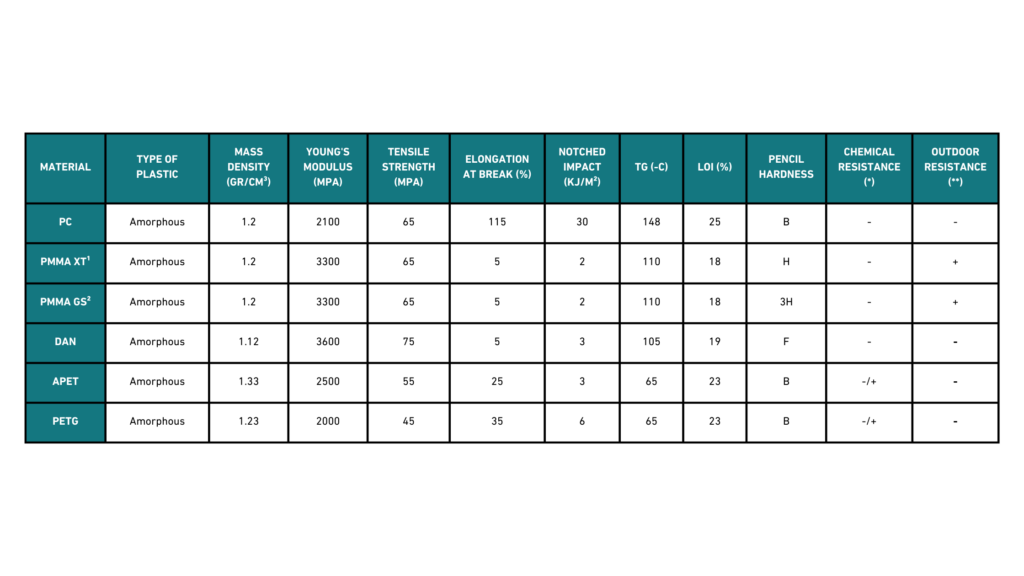
Source: Vegt, van der, A. K., & Govaert, L. E. (2003). Polymers : from chain to plastic
* Chemical resistance on pure material, without coating and compared to glass on acids, alkalis and organic solvents.
** Outdoor resistance on pure material, without coating or coextruded coatings and compared with glass
1) Extruded sheet of PMMA
2) Cast sheet of PMMA
Young’s modulus, tensile strength and elongation at break measured according to ISO 527
Impact strength measured according to ISO 180/1A
LOI = oxygen limit index according to ASTM D2863
Pencil hardness measured according to ASTM D3363
Coatings: enhancing performance
With Viewtec, we improve the performance of thermoplastics by applying special coatings. These coatings increase the chemical resistance and abrasion resistance of the materials, making them perform even better compared to glass.
Practical applications of coated thermoplastics
- Outdoor glazing: PMMA is ideal for outdoor use because of its high light transmission and weather resistance.
- Safety glazing: Polycarbonate is often used in safety-critical applications because of its superior impact resistance.
- Industrial applications:
- APET and PETG are well suited to environments where chemical resistance and moisture resistance are crucial.
Cost considerations and environmental impact
Although glass can be cheaper per kilogram than plastics, thermoplastics often offer a more cost-effective solution. This is due to advantages in design, production, service life and recycling:
- Design: Lighter glazing and supporting structures.
- Production: Easier processing and lower energy costs.
- Service life: Less frequent replacement thanks to higher impact resistance.
- Recycling: Less energy needed for recycling, reducing environmental impact.
Conclusion
Transparent thermoplastic sheet materials offer a versatile and cost-effective alternative to glass, especially in applications where weight, impact resistance and easier processing are important. At Viewtec, we can further enhance the performance of these materials with specialized coatings, making them even more attractive for a wide range of applications.
Whether you are looking for glazing solutions for vehicles, industrial applications or outdoor use, thermoplastics such as polycarbonate, PMMA, … offer numerous advantages. By applying the right selection criteria, you can choose the material that best suits your specific needs and projects.
For more information and tailored advice, you can always contact our ViewTec experts. We will be happy to help you find the best solution for your glazing needs!
INTERESTED IN TRANSPARENT THERMOPLASTIC SHEET MATERIALS?
Goolderheideweg 11,
3950 Bocholt
+32 (0)89 46 93 30
info@zweko-optics.com
BE0840.886.961